Can I walk on marine flexible solar panels? This question sounds simple, but the answer depends on panel construction, deck design, and manufacturer instructions. A flexible panel may bend under light pressure, yet bending does not make it walkable. Its thin cells can crack beneath a shoe, especially over a hard surface or raised fastener.
Marine solar engineer David Findlay explains, “A flexible panel is not a walking surface; it is a power-generating surface.” That distinction matters on boats. Wet footwear can hide small debris, such as sand or salt crystals. One misplaced step may create microcracks that reduce output without visible damage. The panel might still charge today. Its performance could decline slowly over several weeks.
Some marine panels use reinforced laminates and textured coatings. These designs may tolerate occasional contact during installation or emergency movement. They still should not be treated like deck flooring. Check the product’s load rating, installation guide, and warranty language. Do not assume “walkable” means unlimited foot traffic.
A practical test is not enough.
Pressing a panel with your hand cannot reproduce a sharp heel load. A person weighing 80 kilograms can place much greater pressure on one small contact point. My cautious view is clear: avoid walking on marine flexible solar panels whenever possible. Create a narrow, non-slip pathway beside them. If stepping over a panel is unavoidable, use clean, flat footwear and distribute your weight carefully. Even then, damage remains possible. The safest answer is usually no.
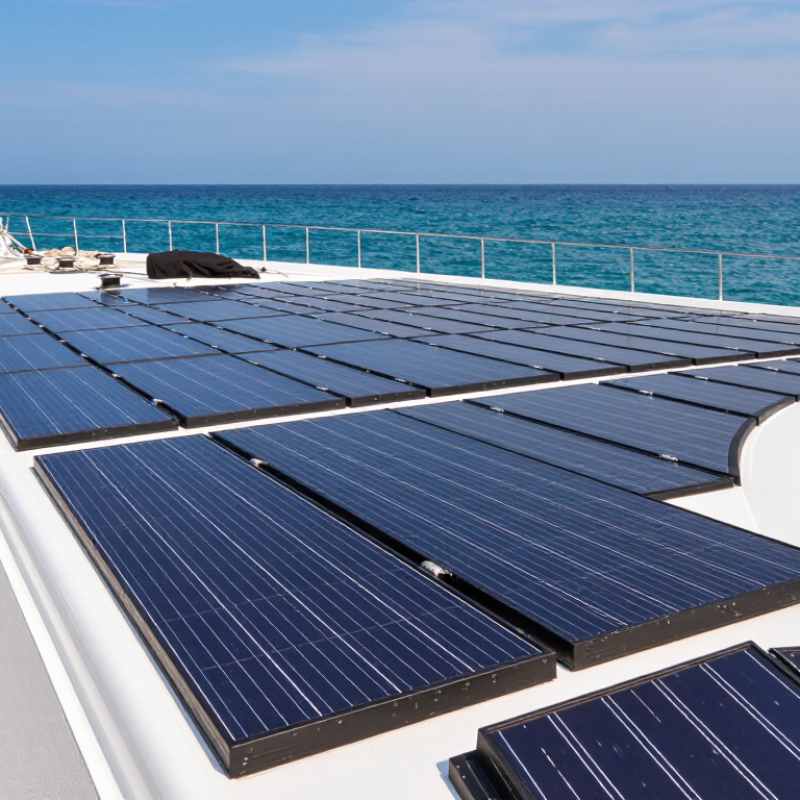
Can You Walk on Marine Flexible Solar Panels?
Marine flexible solar panels are lightweight power surfaces designed for boats, cabins, and other exposed marine areas. Their construction differs from rigid glass modules. A thin photovoltaic layer is sealed between protective polymer sheets, then bonded to a flexible backing. This structure reduces weight and allows the panel to follow a slightly curved deck.
The outer surface usually resists salt spray, sunlight, and occasional moisture. However, flexible does not mean walkable. Most panels are built to carry their own weight, not repeated pressure from shoes, tools, or dropped equipment. A knee, heel, or sharp object can damage internal cells without leaving an obvious mark. That damage may reduce output over time.
Not quite.
Some marine panels include reinforced, non-slip surfaces and may tolerate limited foot traffic. Their installation instructions must clearly permit walking. Even then, I would avoid stepping on them whenever possible. A clean deck layout, raised mounting points, or a narrow service path offers better protection. In real use, wet footwear creates another problem: slipping can injure someone and stress the panel edge. The panel may look tough, but appearance is not a load rating. Manufacturers should provide test data, surface limits, and mounting guidance, yet these details are sometimes overlooked by installers. That gap deserves careful thought.
Can You Walk on Marine Flexible Solar Panels?
Marine flexible solar panels are usually designed to follow a curved deck, not to carry human weight. Their thin laminate can bend over a smooth surface, but bending is different from supporting a person. A standing adult creates concentrated pressure beneath heels, knees, or boot edges. That pressure may crack photovoltaic cells, crease electrical layers, or damage sealed connections.
In practical deck inspections, damage often appears slowly. The panel may still produce power after one careless step. Output can then decline weeks later. Saltwater, heat, and repeated flexing make the problem harder to identify. A wet panel is also slippery, creating a fall risk. Do not use it as a walkway.
Some panels can tolerate brief, distributed pressure during careful installation. That does not mean they support routine foot traffic. A rigid backing board may spread weight, but it can also trap heat or stress the panel if poorly fitted. The installation surface must remain smooth, clean, and free from sharp fasteners. Follow the product’s tested load limits, not assumptions based on thickness.
Measure twice.
If crew access is unavoidable, create a separate walking path beside the solar surface. Raised rails, non-slip strips, or a nearby service platform can protect both people and equipment. I would still recheck the wiring and power output after any accidental step, because visible damage is not always immediate.
| Evaluation Dimension | Typical Technical Fact | What It Means for Walking | Safety Assessment |
|---|---|---|---|
| Primary design purpose | Flexible marine solar panels are designed to convert sunlight into electricity while remaining lightweight and adaptable to curved surfaces. | Electrical output is the main design objective, not repeated pedestrian traffic. | Do not assume walk-on capability. |
| Human load example | An 80 kg person produces approximately 785 N of gravitational force using the standard acceleration of 9.81 m/s². | The load is concentrated under the feet rather than distributed evenly across the panel. | Concentrated loading creates a higher damage risk. |
| Approximate foot pressure | If both feet provide a combined contact area of about 0.04 m², an 80 kg person produces roughly 19.6 kPa of average static pressure. A single foot or heel produces substantially more. | Small contact areas can stress the front surface, cells, wiring, and bonded layers. | Average pressure alone does not prove panel strength. |
| Load distribution | A rigid deck or backing structure can distribute loads; a flexible panel installed over unsupported gaps cannot distribute them as effectively. | Deflection may increase bending stress and can create hidden internal damage. | Avoid stepping over unsupported areas. |
| Solar-cell construction | Crystalline silicon cells are thin and electrically interconnected; visible surface damage is not required for microcracks or electrical faults to occur. | A panel may continue producing power while suffering reduced output or shortened service life. | Damage may be hidden and cumulative. |
| Surface material | Marine flexible panels commonly use polymer-based protective layers rather than a walk-on structural deck. | The surface may resist moisture and weather but still be vulnerable to puncture, abrasion, or point loading. | Weather resistance is not the same as walk-on strength. |
| Slip and fall risk | Water, algae, salt residue, and smooth protective surfaces can reduce traction on marine equipment. | A person may slip even if the panel itself remains undamaged. | There is a separate personal-injury hazard. |
| Electrical safety | Solar panels generate electrical voltage whenever exposed to light, even when disconnected from a battery. | Damaged cables, connectors, or insulation can increase shock, arcing, or short-circuit risks. | Do not walk on panels with damaged wiring or connectors. |
| Installation support | A fully bonded installation on a smooth, continuous deck provides better support than a loosely placed panel or an installation with air gaps. | Good bonding can reduce movement but does not automatically make the panel structurally walkable. | Installation quality reduces risk but is not a warranty. |
| Occasional emergency step | A single carefully controlled step on a fully supported panel may not cause immediate visible damage, but performance loss cannot be ruled out. | Footwear, sand, sharp objects, twisting, and jumping increase the risk substantially. | Avoid unless the product documentation explicitly permits it. |
| Repeated foot traffic | Repeated loading introduces fatigue, abrasion, contamination, and repeated bending that can accelerate degradation. | Decks, walkways, and boarding areas are unsuitable locations unless specifically engineered for foot traffic. | Not recommended. |
| How to verify a walk-on claim | Look for explicit documentation stating walk-on use, allowable load, test method, supported-span conditions, footwear limits, and warranty coverage. | A general load rating or weather rating is not sufficient evidence of walk-on capability. | Use documented specifications only. |
| Practical conclusion | Most marine flexible solar panels should be treated as non-walkable unless the exact product is expressly designed, tested, and warranted for human foot traffic. | Route people around the panel or install a separate raised walkway or protective deck. | Best practice: Do not walk on marine flexible solar panels. |
Note: Actual load capacity depends on the panel construction, support spacing, bonding method, surface condition, and documented test results. Never infer walk-on capability from wattage, thickness, waterproofing, or flexibility alone.
Usually, no. Marine flexible panels are built for low weight and curved surfaces, not repeated foot traffic. A heel or knee creates concentrated pressure across a small area. That stress can crack conductive layers, crease cells, or weaken the bond beneath the panel. Wet surfaces also increase slipping risk, especially when salt, algae, or fine sand forms a thin film.
Surface durability depends on more than the top film. Ultraviolet exposure, salt spray, temperature changes, trapped moisture, and deck movement all accelerate wear.
IEC 61215 and IEC 61730 evaluate photovoltaic performance, mechanical loading, and electrical safety. IEC 61701 addresses salt-mist resistance. However, passing these tests does not automatically make a panel walkable. A certification is not a promise for every boat deck.
The National Renewable Energy Laboratory’s review of more than 2,000 photovoltaic systems reported a median degradation rate near 0.5% per year for crystalline-silicon modules. Flexible marine construction can behave differently, particularly after repeated bending and moisture exposure. That comparison has limits.
I would inspect for bubbles, edge lifting, soft spots, exposed conductors, and deep wrinkles before any contact. Never step on a damaged or energized surface. Even occasional access can shorten service life, because one careless heel may create damage that remains invisible for weeks.
Can You Walk on Marine Flexible Solar Panels?
Walking on marine flexible solar panels can create serious risks, even when the surface appears strong. Most flexible panels use thin laminated layers rather than rigid protective glass. They may support light handling, but that does not make them suitable as regular flooring. Not a walking surface.
A person’s weight can produce small cracks in photovoltaic cells. These cracks may remain invisible while reducing power output over time. Footwear can also scratch the coating or puncture the laminate with trapped sand. Salt water makes the problem worse. Moisture may enter damaged edges, causing delamination, corrosion, or unreliable electrical connections. A wet panel can also become surprisingly slippery. One careless step may cause both equipment damage and a fall.
Movement at sea adds another concern. Decks flex, vibrate, and shift under waves, so pressure is rarely distributed evenly. A knee, heel, or dropped tool can create a concentrated load. Marine technicians usually keep a clear access route beside the panels and use protective walkways where maintenance is unavoidable. They inspect for bubbles, lifted edges, cloudy areas, and loose cables before touching the installation. The safest rule is simple: walk on a flexible panel only when its technical documentation specifically permits foot traffic. Even then, clean soft-soled footwear and careful weight placement matter. I once considered a panel’s tough texture reassuring, but appearance proves very little. A short inspection can prevent an expensive mistake.
Can You Walk on Marine Flexible Solar Panels?
Marine flexible solar panels are not walking surfaces. Their thin laminates can tolerate limited, distributed pressure, but a heel, knee, or dropped tool creates concentrated force. Saltwater, trapped moisture, and repeated flexing can worsen hidden cracks. Not a walkway.
IEC 61215 mechanical-load testing confirms performance under defined laboratory pressure. It does not approve routine foot traffic or human access. The IEA PVPS Trends 2024 report recorded about 446 GW of new photovoltaic capacity in 2023. That scale makes safe inspection practices more important, especially on compact vessels where panels often occupy useful deck space. A panel’s label rarely tells the whole story.
Use an adjacent deck, a temporary load-spreading board, or a dedicated raised walkway. The support should bear on the vessel’s structure, not directly on the laminate. Keep tools in a secured pouch, and use soft, non-abrasive footwear. A stable work platform is safer than balancing across wet modules. Keep feet off.
For maintenance, inspect from the perimeter whenever possible. Use an extension pole, low-pressure water, and manufacturer-approved cleaning methods. Isolate damaged wiring before touching it, and stop work during rain or heavy swell. The U.S. National Renewable Energy Laboratory has reported median PV degradation near 0.5% annually, but marine exposure can accelerate failures when salt deposits and mechanical stress combine. That figure is not a marine guarantee. A better inspection plan records flex points, cable entry areas, fasteners, and recurring moisture marks.
Safer access methods reduce concentrated loads on flexible solar modules. The comparison below estimates static pressure from an 80 kg person using typical contact areas. Actual walking loads can be higher, and a lower pressure value does not prove that a panel is walkable.
Key takeaway: Avoid direct foot traffic unless the panel and its installation are specifically certified for it. Use designated walkways, removable service boards, or access from adjacent deck areas instead.
Usually, no. These panels follow curved decks but are not designed for routine foot traffic. Not a walkway.
A heel or boot edge creates concentrated pressure. It may crack cells, crease layers, or loosen sealed electrical connections. Damage may appear later.
Yes, output may continue immediately after an accidental step. Hidden cracks can reduce performance weeks later. I would not trust appearance alone.
Yes. Water, salt, and smooth coatings can make the surface slippery. A fall could injure someone and damage nearby wiring.
Some tolerate brief, distributed pressure during careful installation. This does not approve regular walking. Follow the tested load limits.
A properly fitted board can spread weight across a wider area. It must rest on the vessel’s structure, not directly on the laminate. Poor fitting can trap heat or create new stress.
Use an adjacent deck, raised walkway, or separate service platform. Keep tools secured in a pouch. Soft, non-abrasive footwear helps protect nearby surfaces.
Inspect for bubbles, lifted edges, cloudy areas, scratches, and loose cables. Recheck power output and wiring after the panel dries. Stop if damage seems uncertain.
Marine flexible solar panels are lightweight, low-profile power systems designed to conform to curved surfaces on boats and other marine structures. Their construction typically combines solar cells, protective coatings, and flexible backing materials, making them easier to install than rigid panels but generally less resistant to concentrated pressure. The question “Can I walk on marine flexible solar panels?” does not have a universal yes-or-no answer, because safety depends on the panel’s design, surface reinforcement, installation method, and manufacturer’s instructions.
Even when a panel appears strong enough to support a person, walking on it can create pressure points, damage electrical connections, scratch protective layers, reduce efficiency, or cause hidden cracks that worsen over time. Saltwater, heat, moisture, movement, and poor installation can further reduce durability. For safer access and maintenance, use designated walkways, nearby deck areas, removable platforms, or stable support equipment, and avoid placing tools or sharp objects directly on the panels.

Sypower Solar