2026 Top Guide How to Wire Flexible Solar Panels in Series?

Time:2026-09-27 Author:Mason
0%

Flexible solar panels can make a compact system easier to fit on a van roof, boat, or curved surface. Yet connecting several panels is not just a matter of joining matching wires. In a series circuit, one panel’s positive lead connects to the next panel’s negative lead, increasing the system voltage while keeping current roughly at the level of one panel. Small details matter. Shade from a roof rack, a loose connector, or mismatched panel ratings can affect the whole string.

This guide explains How to wire multiple flexible solar panels in series? It covers basic planning, compatible components, polarity checks, and safe testing with a multimeter. You’ll also see why the panel label and charge controller limits must be checked before making connections. Measure twice. Flexible panels can be convenient, but their mounting surface may trap heat, and repeated bending can damage cells or conductors. That part is easy to underestimate. Follow the manufacturer’s instructions, use connectors rated for the system, and keep the panels disconnected while assembling the string. If readings seem inconsistent, pause and recheck the wiring rather than guessing. Series wiring can be a practical choice when higher voltage suits your controller and cable run, but it is not automatically the best setup for every installation. A little planning helps prevent a small wiring mistake from becoming an expensive one.
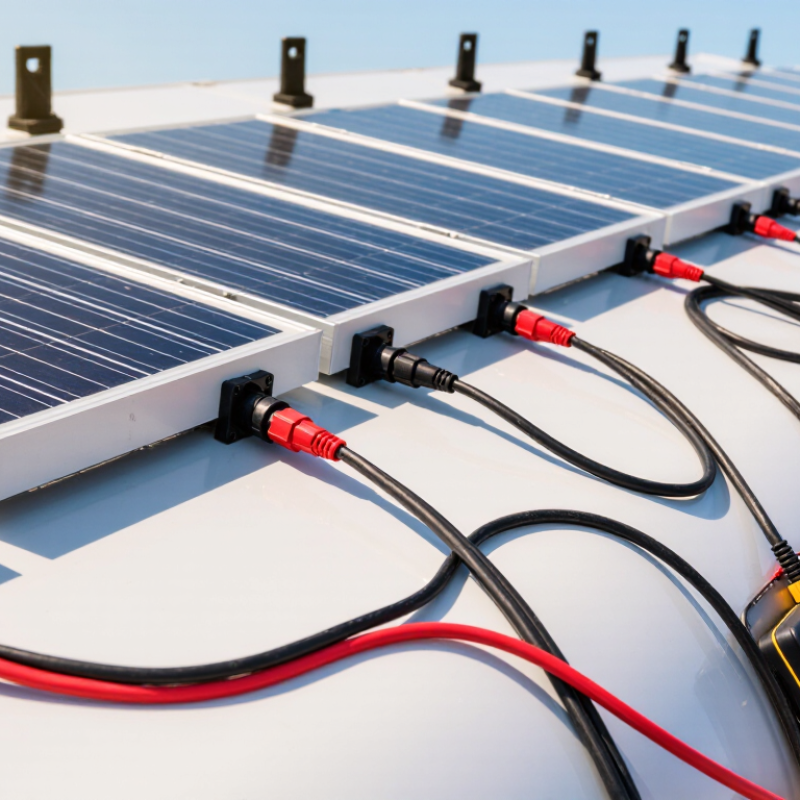
2026 Top Guide How to Wire Flexible Solar Panels in Series?

Identify Panel Ratings: Voc, Vmp, Isc, and Maximum System Voltage

Before wiring flexible solar panels in series, read each label in daylight and record four values: Voc, Vmp, Isc, and maximum system voltage. Voc is open-circuit voltage; series Voc values add together. Vmp is the voltage expected near the panel’s operating point, and it also adds in series. Isc is short-circuit current; in a series string, current stays close to one panel’s Isc. Do not confuse these figures. They describe different conditions. NREL’s PVWatts documentation notes that actual output varies with irradiance and cell temperature, so label values are reference points, not guaranteed field readings.

Cold weather matters. Panel Voc generally rises as cell temperature falls, so estimate the coldest-site Voc before connecting panels. The corrected string voltage must remain below the controller’s maximum input voltage and every panel’s maximum system voltage. IEC 62548 addresses PV array design and electrical protection; use its requirements alongside the equipment manuals. For example, three panels rated at 24 V Voc do not automatically make a safe 72 V string in winter. Check the temperature coefficient and local minimum design temperature. Also compare Isc with the controller’s input-current limit and use suitable conductors and protection. Small detail, big consequence. I would verify the arithmetic twice; a neat label can still hide an unsuitable series combination.

Calculate Series String Voltage: Add Voc and Vmp, Keep Current Unchanged

In a series string, connect one panel’s positive lead to the next panel’s negative lead. Add each panel’s voltage; the string current stays near the current of its lowest-current panel. For three flexible panels rated Voc 24.6 V, Vmp 20.5 V, and Imp 5.8 A, the string reaches 73.8 V open circuit and 61.5 V at maximum power, while current remains about 5.8 A. Check the panel labels, not just the product listing.

These ratings are measured at standard test conditions: 1,000 W/m² irradiance and 25°C cell temperature, as defined in IEC 60904-3. Real panels can run hotter or colder. Cold conditions can raise Voc, so calculate the corrected string Voc and compare it with the charge controller’s maximum input voltage. Hot conditions can lower Vmp; verify that the string still exceeds the controller’s minimum operating voltage. Leave room for measurement error. It is easy to overlook.

NREL’s review of photovoltaic degradation reports a median annual degradation rate near 0.5% across the studies examined, but aging does not replace safe string design. Inspect connectors, cable condition, and panel compatibility before wiring. A loose connection can undermine a neat voltage calculation. Reference: Jordan and Kurtz, “Photovoltaic Degradation Rates—An Analytical Review,” Progress in Photovoltaics, 2013; IEC 60904-3, terrestrial photovoltaic measurement reference spectrum.

How to Wire Flexible Solar Panels in Series

Example string-voltage calculation using identical panels rated at Voc 22.5 V, Vmp 18.5 V, and Imp 5.41 A.

In a series string, panel voltages add while current remains approximately the same: Voc and Vmp totals are multiplied by the number of identical panels, and Imp stays at 5.41 A. Check the corrected cold-weather Voc against the charge controller or inverter’s maximum input-voltage limit before connecting panels.

Adjust Cold-Weather Voc Using the Panel Temperature Coefficient

Cold air can push a series string beyond its expected voltage. At standard test conditions, photovoltaic module ratings use a cell temperature of 25°C and irradiance of 1,000 W/m², as defined in IEC 60904-3. The National Renewable Energy Laboratory’s PVWatts documentation also treats module temperature as a key factor in energy estimates. For wiring, though, use the panel’s published open-circuit voltage (Voc) temperature coefficient and the lowest expected site temperature—not an average winter temperature.

For example, a flexible panel rated at 40 V Voc with a coefficient of −0.28%/°C may reach about 43.9 V at −10°C. That is a 9.8% increase from its 25°C rating. Three panels in series could therefore approach 131.8 V before allowing for measurement tolerance or unusual conditions. Check the charge controller’s maximum PV input voltage against the corrected string voltage. A small mismatch on paper can become a damaged controller on a clear, freezing morning.

Tips: Convert the coefficient to a decimal, then use: corrected Voc = rated Voc × [1 + coefficient magnitude × (25 − minimum temperature)]. Add each panel’s corrected Voc for a series string. Verify the coefficient units and temperature range in the datasheet; flexible panels can differ. I’d still leave a safety margin. Cold-site temperature estimates are not perfect, and that detail is easy to underestimate.

Check Inverter Limits and IEC 62548 String-Design Requirements

When wiring flexible solar panels in series, the string voltage adds, but its current remains close to that of one panel. Check each panel’s open-circuit voltage and short-circuit current on its datasheet. Then calculate the cold-weather string voltage using the manufacturer’s temperature coefficient. It must stay below the inverter’s maximum DC input voltage. Check the inverter’s operating-voltage range too; a string can meet the maximum limit yet perform poorly outside that range. Small detail, big consequence.

IEC 62548 sets design principles for PV arrays, including string sizing, wiring, protection, and isolation. Use the edition adopted for your project, and confirm local requirements with a qualified installer. The IEA PVPS Snapshot of Global PV Markets 2025 reports roughly 600 GW of solar capacity added worldwide in 2024. That scale makes careful design more than paperwork.

Flexible modules can also warm quickly on a roof or vehicle surface, changing output from expectations. Do not assume identical panels will always share current perfectly. Check connector compatibility, cable ratings, bypass-diode guidance, and inverter limits before connecting anything. A neat-looking series string is not proof of a safe design.

Connect Panels in Series and Verify Polarity, Voltage, and Continuity

Before wiring flexible solar panels in series, place them on a clean, stable surface and check each panel’s positive and negative leads. Series wiring joins one panel’s positive lead to the next panel’s negative lead. The two unused leads become the array output. Keep it dry. Follow the panel instructions, and avoid creasing or sharply bending the laminate while handling it. A small connector-labeling mistake is easy to make, especially when leads look alike, so mark them before joining.

With the panels disconnected from other equipment, use a multimeter set to DC voltage to check each panel’s open-circuit voltage. Then measure across the two free array leads; the reading should be close to the individual panel voltages added together, subject to sunlight and temperature. Confirm polarity at the output before connecting a charge controller or other device. For continuity, isolate the wiring and use the meter’s continuity mode only on unpowered conductors; never use it on a live circuit. A zero or unexpected reading deserves another check. Recheck the meter setting, probe contact, and connector seating rather than assuming the panel is faulty.

FAQS

What changes when solar panels are connected in series?

Their voltages add, while current stays near the lowest panel’s current. For three panels rated 20.5 V and 5.8 A, expect about 61.5 V and 5.8 A at maximum power.

How do I calculate a series string’s open-circuit voltage?

Add the panels’ Voc ratings. Three panels rated at 24.6 V each total 73.8 V under standard test conditions. Real temperatures change that figure.

Why does cold weather affect string voltage?

Cold can raise Voc. Use the panel’s temperature coefficient and the site’s lowest expected temperature, not its average winter temperature. I might still underestimate a cold clear morning.

How can I estimate corrected Voc in cold conditions?

Use: corrected Voc = rated Voc × [1 + coefficient magnitude × (25 − minimum temperature)]. Convert the coefficient to a decimal. A 40 V panel with a −0.28%/°C coefficient reaches about 43.9 V at −10°C.

What should I check before connecting a string to a charge controller?

Compare cold-corrected string Voc with the controller’s maximum input voltage. Also confirm that hot-weather Vmp stays above its minimum operating voltage. Leave a margin.

How do I connect panels in series?

Connect one panel’s positive lead to the next panel’s negative lead. The two unused leads form the array output. Mark polarity first. Leads can look confusing.

How can I verify the string voltage and polarity?

With panels disconnected from other equipment, measure each panel’s DC open-circuit voltage. Then measure across the free array leads; the reading should be close to their added voltages. Check output polarity before connecting equipment.

Is it safe to use continuity mode on connected wiring?

No. Isolate the wiring and use continuity mode only on unpowered conductors. If the reading seems unexpected, check meter settings, probe contact, and connector seating. Recheck calmly.

Conclusion

How to wire multiple flexible solar panels in series? Begin by checking each panel’s nameplate ratings: open-circuit voltage (Voc), operating voltage (Vmp), short-circuit current (Isc), and maximum system voltage. In a series string, the panels’ Voc values add together, as do their Vmp values, while the string current remains approximately the same as that of one panel. Compare the resulting values with the inverter’s permitted input range and the system’s voltage limit.

Account for cold weather, which can raise Voc. Use the panel’s temperature coefficient and the lowest expected site temperature to estimate the maximum string voltage, then confirm the design meets applicable IEC 62548 string-design requirements. With the system safely isolated, connect each panel’s positive lead to the next panel’s negative lead. Before connecting the string to equipment, verify polarity, measure voltage, and check continuity against the expected values.

Mason

Mason

Mason is a seasoned marketing professional with a deep expertise in the company's offerings and a passion for driving brand awareness. With a strong background in digital marketing strategies, he has an innate ability to connect with diverse audiences and effectively communicate product benefits.......